
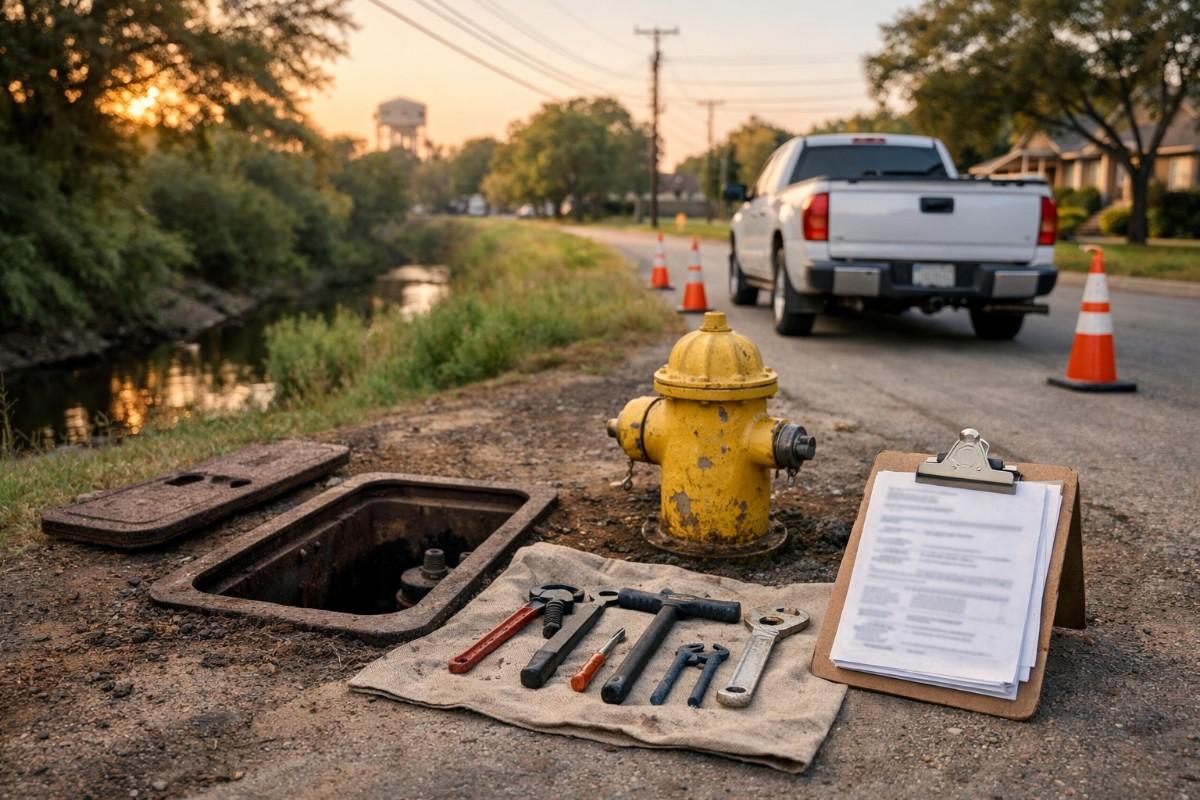


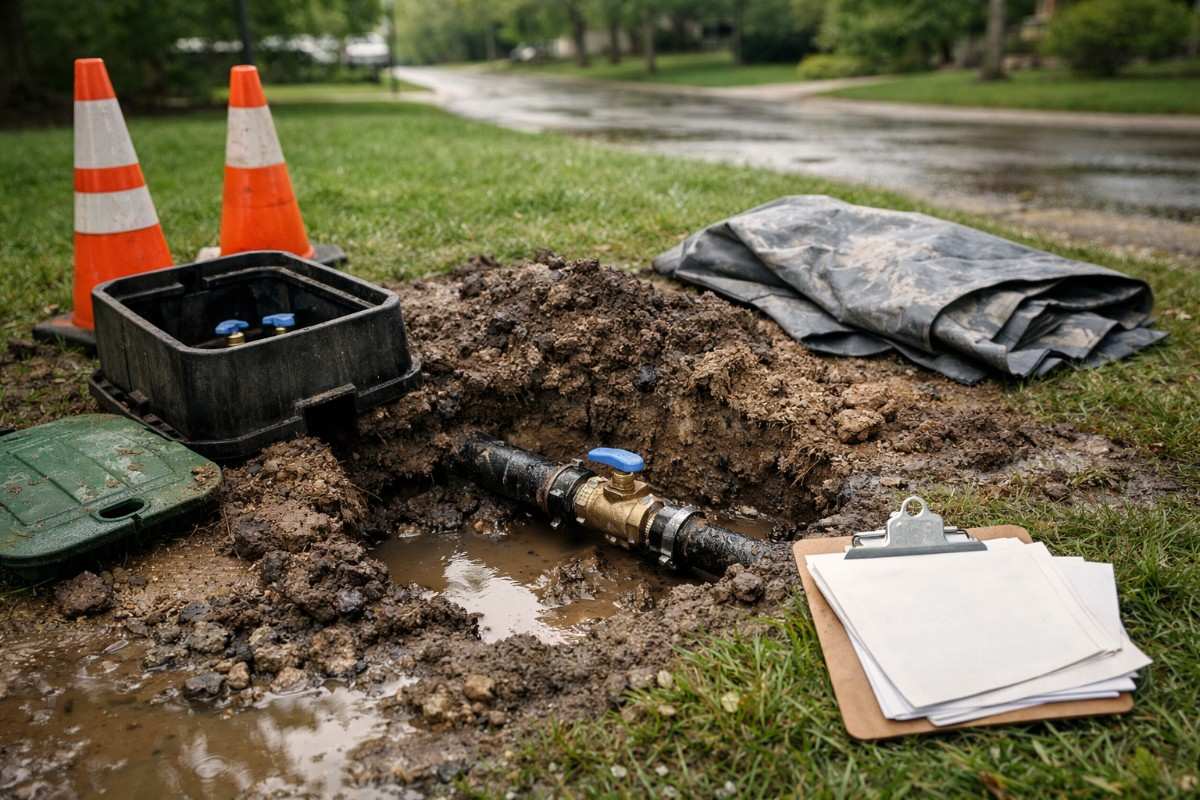
Your most experienced field supervisor just announced retirement. He has been running work orders for 22 years. He knows which valve needs three full turns before it seats, which hydrant throws a false pressure reading, and which meter pit floods after rain. None of that is written down anywhere. It lives in a notebook on his truck, or more often, in his head.
This is the operational reality that makes work order management one of the highest-priority systems a water utility can get right. It is not just about tracking tasks. It is about capturing, standardizing, and executing the institutional knowledge that keeps water flowing and customers billed correctly.
Work order management in water utilities refers to the systematic process of creating, assigning, executing, and closing field work tasks, from routine meter inspections to emergency main repairs. It covers the full lifecycle of every work request, connects field crew activity to billing and asset records, and ensures regulatory compliance is documented at every step.
In practice, this means that every task your field crews perform, whether it is responding to a customer complaint, replacing a failing meter, or conducting a scheduled valve exercise, everything is initiated, tracked, and completed through a defined workflow rather than by phone call, paper slip, or tribal knowledge.
For small and mid-sized water utilities, effective work order management is the operational backbone that connects customer service, field operations, billing, and asset management into a coherent system. When it works well, customers get accurate bills, field crews know exactly what they are doing and why, and managers have real-time visibility into what is happening in the field. When it breaks down, through lost paperwork, miscommunication, or undocumented completions, the consequences show up as billing errors, missed regulatory deadlines, and service failures.
Not all work orders are created equal. Understanding the distinction between the two primary types is essential for building a work order system that serves both your field operations and your billing department.
The reason this distinction matters: service orders and maintenance work orders follow different workflows, require different documentation, and have different downstream effects. A service order that is not properly closed out does not just leave a task undone, it leaves a billing record incomplete, which means the next meter read may be applied to the wrong rate, the wrong address, or an account that has already been closed.
Maintenance work orders, on the other hand, feed your asset management system. Every inspection, repair, and replacement builds a condition history that informs capital planning decisions. A utility that does not close out maintenance work orders systematically is flying blind on infrastructure lifecycle.
A well-managed work order moves through a predictable sequence of stages. Each stage has a defined owner, a defined input, and a defined output. Understanding this lifecycle is the starting point for identifying where your current process breaks down.
1. Creation - A work request is logged in the system, either by a customer service representative (service orders), by the scheduler (planned maintenance), or by a field crew calling in a field observation (corrective maintenance). The request is classified by type, priority, and location.
2. Assignment and Dispatch -The work order is assigned to a field crew or technician based on skill, location, and availability. In a digital system, the technician receives the job on a mobile device with the customer or asset details, location, standard operating procedure, and any relevant notes from prior visits.
3. Field Execution - The technician completes the work at the site, documents the outcome (including photos, readings, parts used, and any complications),and updates the work order status in real time via mobile app.
4. Quality Check and Approval - The supervisor or dispatcher reviews the completed work order for completeness before approval. Missing documentation - a meter serial number, a final pressure reading, a photo of the installation is flagged before close-out.
5. Close-Out and Record Update -The completed work order triggers downstream updates: for service orders, the linked customer account in the CIS is updated; for maintenance work orders, the asset record is updated with the new condition rating, parts replaced, and date of service. See water utility asset management for how this connects to your infrastructure lifecycle tracking.
6. Reporting and SLA Tracking - Work order performance metrics, first-time completion rate, mean time to repair (MTTR), SLA adherence by job type are logged and available for management review, regulatory reporting, and crew performance evaluation.
In a paper-based system, steps 3 through 6 are where things fall apart. Field notes get lost, close-outs get delayed, and billing records go weeks without being updated. In a digital system connected to your CIS and asset register, close-out is automatic and instantaneous.
The operational link between workorder management and billing is one of the most underappreciated and most consequential relationships in utility management. Most utilities understand this in theory but have systems that do not enforce it in practice.
Here is the problem in concrete terms, a field crew replaces a faulty meter at a residential account. The meter serial number changes. The new meter reads from zero. If the work order close-out does not automatically update the CIS with the new meter ID, the start read, and the installation date, the next billing cycle will apply the new meter's reading to the old meter's rate class and zero-point baseline. The customer gets a wrong bill. Your billing staff spends time on a complaint that should never have occurred.
Service orders that affect billing accuracy include:
• New service connections - triggers account creation and the first meter read baseline
• Meter replacements - requires updating meter ID, start read, and read sequence in billing
• Service disconnections and reconnections - affects billing dates and final reads
• Rate class changes - triggered by meter upgrades or account reclassifications
• Leak adjustments and re-reads - require documented field work to support billing corrections
When work orders and billing are managed in the same platform, these updates are automatic. Platforms like utility work order management software built for connected utility operations ensure that a closed service order triggers the exact CIS update needed, no manual re-keying, no delay, no missed meter change. The result is a 60% improvement in customer service speed, driven largely by eliminating the back-and-forth between field completion and billing update.
For many small and mid-sized US water utilities, work order management still runs on a combination of paper forms, phone calls, whiteboards, and spreadsheets. This is not a technology failure, it is the rational outcome of decades of under-investment in operational software for utilities below the enterprise threshold.
But the costs are real, and they compound:
• Retiring workforce knowledge loss: The AWWA estimates that approximately 30% of the US utility workforce is eligible for retirement within five years. Paper-based work order systems mean that institutional knowledge, which equipment to approach with caution, which customers have non-standard meter locations, which lines have known pressure issues, leaves when the person leaves. A digital work order system captures notes, photos, and history that survive staff turnover.
• Dispatch errors and duplicated work: Without real-time visibility into work order status, dispatchers assign jobs that are already in progress or completed. Field crews drive to addresses with incomplete information. Duplicate visits cost fuel, labor, and customer goodwill.
• Compliance gaps: The EPA's Safe Drinking Water Act compliance requirements include documentation of maintenance activity on specific asset types and response timelines for service complaints. Paper records do not generate audit trails. When a state regulator asks for service response documentation for a specific date range, a paper-based utility is searching through binders.
• Revenue leakage: Unlinked service orders -meter replacements or reconnections that are completed in the field but never updated in the CIS create billing gaps. The account continues to bill against a meter that is no longer installed. The revenue leakage is silent and accumulates over months.
Utilities that have moved from paper-based work order management to a connected digital platform report approximately 50% reductions in operational expenditure, primarily through elimination of manual data entry, duplicate dispatch, and overtime spent reconciling incomplete records. See how water utility management software addresses these operational gaps across the full utility operation.
For small and mid-sized water utilities, those operating between 3,000 and 100,000 meters, the right work order software is not the same as what a large metropolitan authority needs. The evaluation criteria are different, and the wrong choice leads to under used systems, poor adoption, and wasted capital.
The capabilities that matter most for utilities your size:
Work orders and billing must share a data layer. If your work order software requires a manual export-import to update the CIS, you have not solved the problem, you have added a step. Look for platforms where service order close-out writes directly to the customer account.
Field crews in water utility work frequently operate in areas without reliable cellular coverage, underground vaults, rural service territories, basement meter rooms. Your work order app must function offline and sync when connectivity is restored. Field techs should be able to capture photos, update readings, and close work orders without needing a signal.
Beyond reactive work orders, your system should support scheduled preventive maintenance, automatic generation of work orders based on time intervals, usage thresholds, or asset condition triggers. This shifts your operation from reactive to proactive and reduces emergency repair costs over time.
A work order that cannot pull meter location from GIS or attach to an asset record in your asset register is an island of data.
The best platforms ship with pre-built integrations to the AMI systems, GIS platforms, and ERP tools utilities already use. SMART360, for example, connects to 25+ pre-built integrations including Sensus, Itron, Landis+Gyr, and Esri, which means workorders draw on accurate field data from day one, without a custom integration project. Review water utility asset management to understand how work order close-out connects to infrastructure lifecycle tracking.
One reason small utilities default to spreadsheets is that enterprise utility software implementations run 12 to 18 months and require dedicated IT resources to manage. That is not realistic for a utility with a two-person IT department. Modern cloud-native platforms like SMART360 are live in 12 to 24 weeks, with training, data migration, and integration included, because the platform is designed for utilities that cannot afford a multi-year implementation project.
For a full overview of the features that matter for water utilities specifically, see utility work order management software built for connected field operations.
A service order is a customer-triggered request, a new connection, meter replacement, disconnection, or reconnection, that links to a specific customer account and affects billing. A maintenance work order is operations-initiated, a scheduled inspection, preventive maintenance task, or corrective repair, that links to an infrastructure asset and updates the asset's maintenance history. Both flowthrough the same work order system but trigger different downstream updates.
Service orders that are completed in the field but not closed out in the CIS create billing gaps. When a meter is replaced and the new meter serial number and start read are not updated in the billing system, the next billing cycle applies the new read to the wrong baseline. Connecting work order close-out directly to CIS updates eliminates this lag and the billing disputes that follow. SMART360 customers report a 50%improvement in billing accuracy after digitizing their work order-to-billing workflow.
At a minimum: work order number, asset or account ID, date and time of arrival and completion, work performed (by type and description), parts used and quantities, any abnormalities observed, meter readings (before and after for service orders), photos of the completed work, and the technician's digital signature. For compliance-tracked work types, chlorine sampling, backflow prevention testing, regulatory documentation fields are required.
Legacy enterprise utility software implementations typically run 12 to 18 months. Cloud-native platforms designed specifically for small and mid-sized utilities run significantly faster. SMART360 goes live in 12 to 24 weeks, including data migration, system configuration, and field crew training. The Island Water Authority completed full implementation in 8 weeks. The implementation timeline is shorter because cloud SaaS platforms do not require on-premise infrastructure setup or lengthy hardware procurement.
Yes. The EPA's Safe Drinking Water Act compliance requirements include documentation of maintenance activity, service response times, and infrastructure condition assessments. Paper records create significant audit risk because they do not generate searchable, time-stamped audit trails. When a state regulator requests service response documentation for a complaint period, a digital work order system produces an instant report; a paper system requires a manual search through physical records.